Business analytics is moving rapidly beyond traditional reporting.
Companies are increasingly using artificial intelligence, real-time data, predictive analytics, and automated systems to understand customers, optimize operations, and make decisions.
Today’s developments highlight an important shift: business data is becoming increasingly valuable when it can directly influence an action.
Here are some of the most important business and data analytics developments to watch today.
1. NIQ and Similarweb Advance Measurement for the AI Shopping Era
Consumer intelligence company NIQ announced a collaboration with Similarweb focused on agentic commerce measurement.
The companies are working on a solution designed to help brands and retailers understand how AI-driven discovery connects with consumer intent, product information, traffic, and sales conversion.
This is significant because customers are increasingly discovering products through AI-powered experiences rather than relying exclusively on traditional search and websites.
For businesses, this creates a new analytics challenge.
Companies need to understand not only:
- How many people visit their website
- Where traffic comes from
- How many people convert
but increasingly:
- How AI systems discover their products
- How products appear in AI-generated recommendations
- Which AI-driven interactions lead to purchases
- How AI-generated traffic converts
- What product information influences AI-assisted buying decisions
Why This Matters
Traditional web analytics was largely designed around human interaction with websites.
Agentic commerce introduces another layer: AI systems may increasingly participate in product discovery and purchasing decisions.
Businesses will therefore need better measurement systems to understand this new customer journey.
Data Analytics Takeaway
Businesses should begin thinking beyond traditional website traffic.
Future analytics strategies may need to connect:
AI Discovery → Product Exposure → Customer Intent → Traffic → Conversion → Revenue
This makes clean product data and reliable measurement increasingly important.
2. AI-Powered Predictive Maintenance Shows the Value of Combining Data With People
A manufacturing operation in Tennessee provides an interesting example of how AI analytics can create measurable operational value.
Domtar had deployed hundreds of vibration-monitoring sensors to detect potential equipment problems. However, analyzing the data from hundreds of sensors manually became difficult.
The company improved the system by working more closely with its sensor provider and combining machine-learning analysis with additional information such as thermal imaging and ultrasonic measurements.
The resulting approach helped identify potential mechanical failures earlier and contributed to avoiding unplanned downtime and reducing energy usage. The report says the system ultimately helped avoid more than 1,500 hours of downtime.
Why This Matters
The important lesson isn’t simply that AI can analyze sensor data.
It is that AI becomes more useful when data, domain expertise, and business processes work together.
The company did not simply deploy an AI model and walk away.
Instead, people helped improve the data, interpret the results, communicate findings, and integrate the analytics into operational decisions.
Data Analytics Takeaway
Businesses considering predictive analytics should ask three questions:
- Do we have enough reliable data?
- Do employees understand how to use the insights?
- Is there a business process that turns the insight into action?
A sophisticated model is less valuable if nobody acts on its predictions.
3. Enterprise AI Demand Continues to Expand
Current business intelligence tracking indicates that enterprise AI remains a major area of business interest.
MarketScale’s September 2 intelligence report says demand for enterprise AI and related technologies continues to rise, with increasing attention also being directed toward AI governance, data centers, and energy infrastructure.
This highlights an important development in the AI market.
Businesses are moving from asking:
“Can we use AI?”
toward asking:
“How do we deploy AI reliably at scale?”
That shift creates demand for:
- Better data infrastructure
- AI governance
- Data quality
- Security
- Analytics platforms
- Automated workflows
- AI monitoring
- Business intelligence
Why This Matters for Businesses
AI is increasingly becoming an operational technology rather than simply an experimental tool.
That means companies need to understand the underlying data architecture supporting their AI systems.
Poor data can produce poor analysis.
And poor analysis can produce poor business decisions.
Data Analytics Takeaway
Before investing heavily in advanced AI, businesses should strengthen the basics:
Clean data → Consistent metrics → Reliable reporting → Trusted analytics → AI
4. AI Is Changing the Software Business Model
Software companies are increasingly moving from treating AI primarily as a competitive threat to viewing it as a potential growth opportunity.
Reuters reported that software stocks rebounded strongly in August as investors responded to improving earnings and evidence that AI products can contribute to business growth. Salesforce, for example, reported strong growth in new annual order value and significant recurring revenue associated with its Agentforce AI product.
This is important because the early AI discussion in software was heavily focused on whether AI assistants would replace traditional software.
The conversation is increasingly shifting toward another question:
How can software companies use AI to create more value?
Why This Matters
AI can potentially change how customers interact with business software.
Instead of navigating through multiple dashboards and menus, users may increasingly ask software systems questions directly.
For example:
“Why did our gross margin decline this quarter?”
An intelligent analytics system could potentially analyze financial data, identify the largest changes, and explain the likely drivers.
This represents a shift from:
Dashboard → Human interpretation
toward:
Question → Data analysis → Insight → Recommended action
Data Analytics Takeaway
Businesses should think about analytics not only as reporting.
The next stage is decision intelligence—using data and AI to help people understand what happened, why it happened, and what they could do next.
5. Strong AI Demand Is Also Affecting Business Infrastructure
Financial markets are continuing to react to the rapid expansion of AI infrastructure.
Reuters reported today that Dell raised its profit and revenue forecast amid strong demand for AI infrastructure, while investors continue to watch the broader AI investment cycle.
The broader implication is that AI is no longer only a software story.
It increasingly affects:
- Data centers
- Servers
- Networking
- Energy
- Cooling
- Storage
- Semiconductor demand
- Enterprise infrastructure
This means businesses evaluating AI investments should consider the total technology environment required to support them.
What Today’s News Means for Business Analytics
Today’s developments reveal several larger trends.
1. Analytics Is Moving Closer to Revenue
The NIQ and Similarweb collaboration shows how analytics is increasingly being connected directly to customer discovery and sales.
Analytics is becoming less about simply reporting traffic and more about understanding which interactions create commercial outcomes.
2. Predictive Analytics Is Becoming More Operational
The manufacturing example demonstrates how predictive analytics can influence maintenance and operational planning.
This means analytics teams increasingly need to work closely with operational teams.
3. Data Quality Is Becoming More Important
AI systems are only as useful as the information they can access.
Businesses investing in AI should therefore also invest in:
- Data quality
- Data organization
- Data governance
- Consistent definitions
- Reliable reporting
4. Dashboards Are Evolving
Traditional dashboards answer questions such as:
What happened?
Modern analytics increasingly attempts to answer:
Why did it happen?
And increasingly:
What should we do next?
That is a major evolution in business analytics.
What Small Businesses Can Learn From These Trends
Small businesses may not need sophisticated enterprise AI systems today.
But they can adopt the same underlying principles.
Start by organizing the data that already exists inside the business.
Track:
- Revenue
- Expenses
- Gross profit
- Net profit
- Cash flow
- Customer activity
- Sales performance
- Budget variance
Then turn those numbers into regular reports and dashboards.
Once the data is organized, more advanced analytics becomes easier to implement.
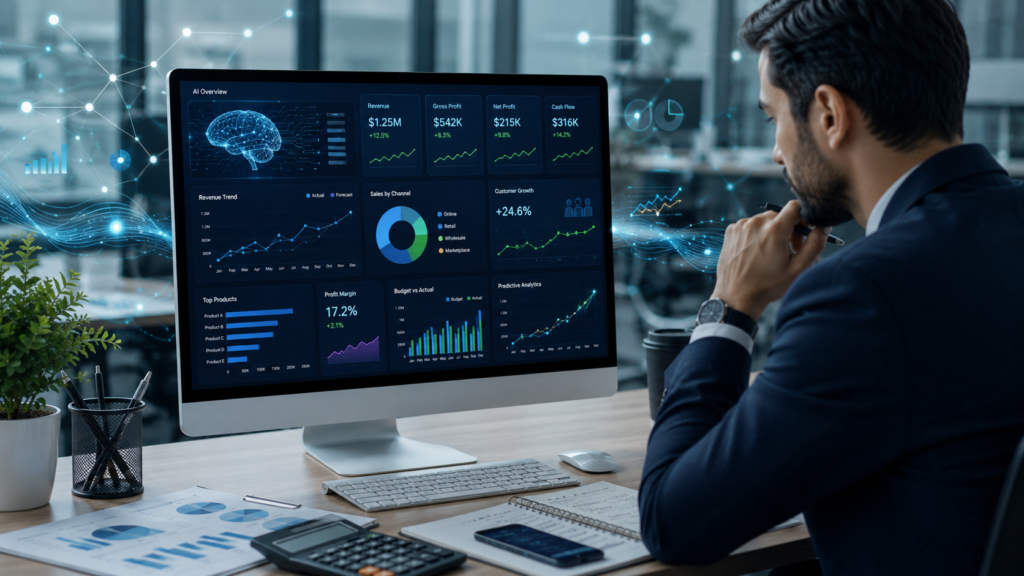
A well-structured business KPI dashboard can provide a useful starting point for monitoring business performance.
Similarly, a financial dashboard can help organize revenue, expenses, profitability, cash flow, and other important financial indicators.
The technology can become more advanced over time.
The foundation should remain reliable data.
A Simple Analytics Framework for Businesses
Businesses can think about their analytics maturity in four stages.
Stage 1: Track
Collect and organize business data.
Stage 2: Report
Create dashboards and regular performance reports.
Stage 3: Analyze
Identify trends, relationships, variances, and problems.
Stage 4: Predict and Act
Use advanced analytics and AI to predict outcomes and support decisions.
Many businesses try to jump directly to Stage 4.
But the strongest systems usually have a solid foundation underneath them.
The Bigger Trend: From Data to Decisions
The most important theme from today’s news is not any individual AI product.
It is the changing relationship between data and decision making.
Businesses have spent years collecting data.
The next challenge is making that data useful at the exact moment a decision needs to be made.
The evolution looks something like this:
Data → Reporting → Analytics → Prediction → Decision → Action
The companies that successfully connect these steps can potentially turn data from a passive business record into an active competitive advantage.
Final Thoughts
Today’s business and data analytics news shows that AI is becoming increasingly connected to real business outcomes.
From measuring AI-driven commerce to predicting equipment failures and improving enterprise software, analytics is moving closer to everyday decision making.
For small businesses, the lesson is straightforward:
You don’t need the most advanced AI system to start becoming data-driven.
Start with reliable data.
Track the KPIs that matter.
Build clear dashboards.
Review performance consistently.
Then gradually introduce more advanced analytics and automation as the business grows.
The future of business analytics isn’t simply about collecting more data. It’s about making better decisions with the data you already have.
Explore Business Analytics Tools from BizAnalyticsMBA
If you’re building a more data-driven approach to managing your business, BizAnalyticsMBA provides practical Excel-based business and financial analytics tools.
A Business KPI Dashboard can help organize important performance indicators into a centralized reporting view.
A Financial Dashboard can help businesses track financial performance, including revenue, expenses, profitability, cash flow, and other financial metrics.
These types of tools provide a practical foundation for businesses that want to improve their reporting before moving toward more advanced analytics and AI systems.
Explore the BizAnalyticsMBA collection:
https://bizanalyticsmba.com
Frequently Asked Questions
What is business analytics?
Business analytics is the process of using business data to understand performance, identify trends, discover problems, and support better decisions.
What is the difference between business intelligence and business analytics?
Business intelligence often focuses on reporting and understanding what happened, while business analytics can go further by investigating why something happened and using data to support future decisions.
Why is data quality important for AI?
AI systems depend on underlying data. Inconsistent, incomplete, or inaccurate data can reduce the reliability of analytics and AI-generated insights.
What is predictive analytics?
Predictive analytics uses historical and current data to identify patterns and estimate potential future outcomes.
Can small businesses use business analytics?
Yes. Small businesses can begin with relatively simple systems such as Excel spreadsheets, KPI dashboards, financial reports, and regular performance reviews.
What KPIs should small businesses track?
Common KPIs include revenue, revenue growth, gross profit, gross margin, net profit, net profit margin, operating expenses, cash flow, and budget variance.
Are AI and business analytics becoming more connected?
Yes. Current business technology developments increasingly combine AI with business data, analytics, automation, and decision-support systems.
What should a business do before adopting advanced AI analytics?
Businesses should establish reliable data collection, consistent metrics, organized data, appropriate governance, and clear business processes for acting on analytical insights.